
Compare
Jev vs ChatGPT
A category contrast, not a quality war. One produces language. The other produces a decision your compiler can see. Jev vs ChatGPT should not be a fan fight.
ChatGPT — and every product in its category — is a conversational generator. You send a prompt. You get tokens intended for a person to read. That is the correct tool for drafting, explaining, tutoring, and open-ended help. Jev vs ChatGPT searches spiked after TypeSafe launched on 15 September 2026 because the landing page refused the chat frame. Good. Keep refusing it.
Jev is not trying to win that game. It does not chat. It does not “sound sure.” It evaluates state against typed questions and returns Choice / Score / Noul with probabilities. Asking which one is “smarter” is like asking whether a hash function is smarter than a novelist. Jev Patterns is not affiliated with TypeSafe AI or with OpenAI. This Jev vs ChatGPT page exists so you pick the right tool without a conversion-shaped insult.
Honest strengths (both sides)
ChatGPT’s strengths are real: long-context writing, tool-using assistants, multimodal input on many SKUs, a product surface millions already know how to talk to. If the artifact is a paragraph, Jev vs ChatGPT is over before it starts. Jev currently has no vision, no code generation, and no “explain why” string. Those absences are documented, not accidents.
Jev’s strengths are also real: a closed answer space, calibrated probabilities, parallel questions, ~70–500ms vendor latency, unmetered output, no JSON repair loop. If the artifact is a queue name, Jev vs ChatGPT should not even call the chat API. Put Jev on the judge. Put ChatGPT (or any writer) on the sentence after the judge.
What each owns
| Job | Chat product | Jev |
|---|---|---|
| Write a reply | Yes | No |
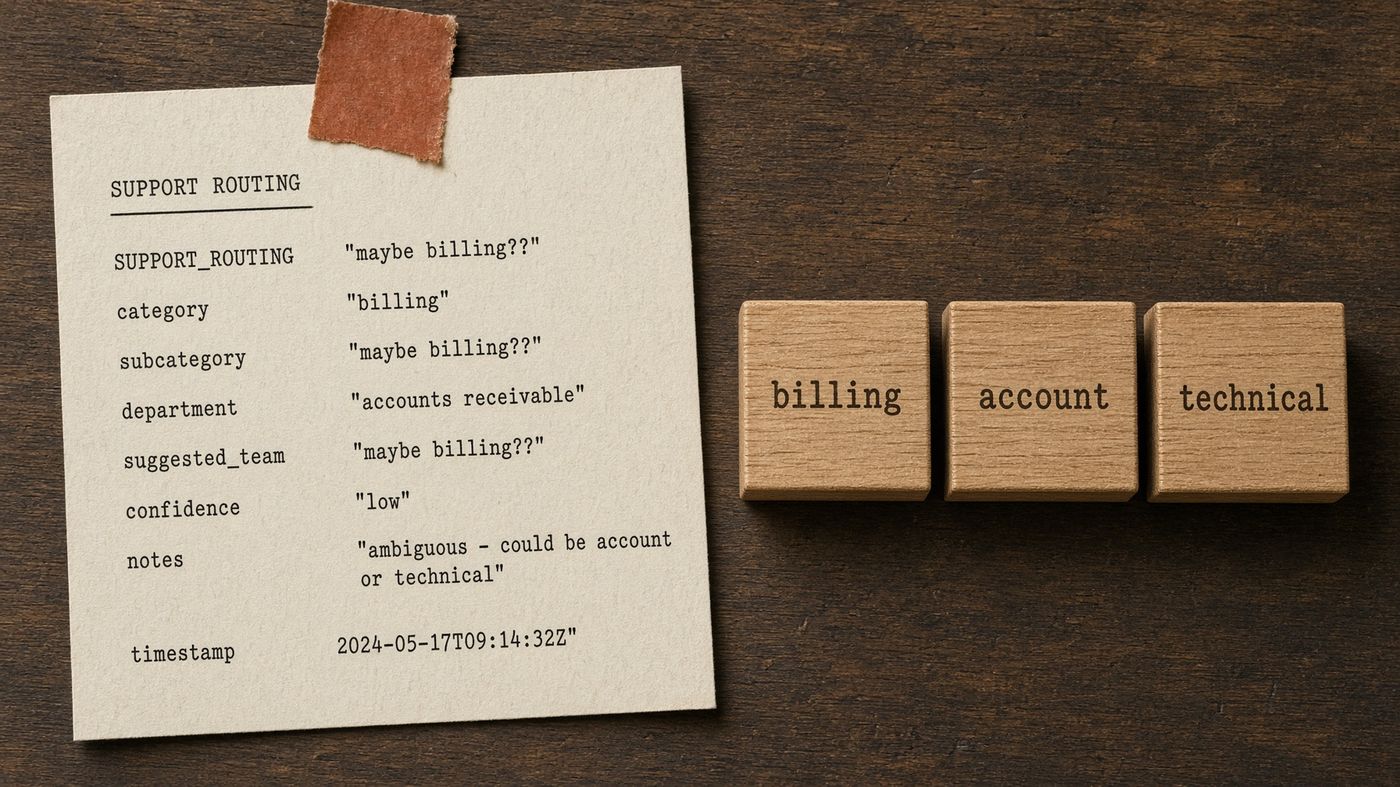
| Route a ticket | You parse a string | Choice over your queues |
| Refuse a groundedness miss | You hope the model says no | Noul + pass/revise/block |
| Latency | Seconds, often more | About 70–500ms |
| Output meter | Tokens you pay for | Unmetered at vendor list |
| Vision | Often yes | Not yet |
| Open-ended tutoring | Yes | No |
Pick ChatGPT, Jev, or both
- Customer needs an explanation, a lesson, or a draft → chat product. Jev vs ChatGPT is not a contest on that job.
- Code needs a queue name, a 0–3 score, or a boolean gate → Jev, using a schema from this site.
- RAG answer that people will read → retrieve, Score chunks, write with a chat model, gate with Jev. Both, in that order.
- Agent that talks while it works → chat model for talk and arguments; Jev for next-tool and continue-or-stop if you want a closed brake.
A serious stack already looks like this: retrieve, judge, then write. Jev sits on the judge. The chat model sits on the write. This site will not put a chat bubble on a System One schema. If a vendor demo shows Jev answering in prose, they wrapped a writer around it — the model contract did not change.
If you arrived from a “ChatGPT for tickets” vendor page, you were sold a generator with a JSON afterthought. Read when not to use Jev so you do not reverse the mistake. Related comparisons: Jev vs JSON mode, Jev vs function calling. Copy a schema from the catalog or run Jev Studio.
Last reviewed 17 September 2026 against public TypeSafe and OpenAI docs. Features move. Re-check vendors before you freeze an RFP. Jev vs ChatGPT will still be a category contrast next quarter.
Jev vs ChatGPT for support, RAG, and agents
Support: ChatGPT (or any writer) can draft. It should not be the thing that assigns the queue if you have a closed set of teams. Put support ticket routing in front. RAG: writers hallucinate with a straight face; Jev vs ChatGPT on the gate is the LLM output guardrail. Agents: ChatGPT-class models are good at filling arguments and talking while they work. They are worse at stopping. Pair them with continue or stop.
None of that requires you to delete ChatGPT. Jev vs ChatGPT is a diagram with two boxes. Teams that collapse the diagram into one box rebuild a chatbot and then ask why confidence is a vibe again.
Procurement check: if an RFP asks for “a chatbot that routes tickets,” split the RFP. Routing is Jev vs ChatGPT in the Jev column. Talking is the chat column. Scoring vendors as if those were one SKU is how you buy a generator and then hire people to parse it. Official Jev pricing and latency live on TypeSafe’s site; official ChatGPT capabilities live on OpenAI’s. This page only argues the split.
Jev vs ChatGPT FAQ
- Is Jev better than ChatGPT?
- Jev vs ChatGPT is the wrong scoreboard. ChatGPT is a conversational generator. Jev is a System One decision model. One writes. One judges. Use both.
- Can Jev replace ChatGPT in a support widget?
- No. Jev vs ChatGPT for the widget itself still picks the chat product. Jev can sit beside it: route, score urgency, escalate.
- Does ChatGPT JSON mode make Jev vs ChatGPT moot?
- No. JSON mode still samples field values as language. See Jev vs JSON mode. Constrained braces are not a closed Choice.
- Who makes Jev vs ChatGPT this comparison?
- Jev Patterns, an independent catalog. Not affiliated with TypeSafe AI or OpenAI. Official Jev docs: docs.typesafe.ai.
- What latency should I expect in Jev vs ChatGPT?
- TypeSafe publishes about 70–500ms for Jev on System One tasks. Chat products are often seconds, especially with tools. Different jobs, different clocks.
Next
Keep comparing

Last reviewed 21 September 2026. Independent of TypeSafe AI.