Closed answer space
Choice, Score, and Noul do not sample a paragraph. Jev Patterns declares the options. TypeSafe Jev fills a distribution over that set.
Independent library · jevpatterns.com
Copy a paste-ready System One request, run it on your state, keep the threshold in your code. Not a chatbot. Not affiliated with TypeSafe AI.

Fixture · Support ticket routing
Open in Studio“Cannot log in. Reset email never arrives.” Closed options, not a drafted reply.
Demo fixture
418 in · 28 out
account
confidence 81%
71%
Probability the statement is true. 50% means unsure, not medium.
How a call works
01
A ticket, a chunk, a tool result, a form. Facts you already have — not a prompt to invent them.
02
Choice, Score, Noul. The answer space is closed before the call. Copy it from a Jev Patterns page.
03
Read the distribution. Auto-apply at high confidence. Ask a human in the middle. Keep the threshold in config.
Then calibrate on your labels. Run a fixture in Studio before you spend a key.
Three primitives
One label from a set you declared. The model fills a distribution. Your router reads the argmax and the peak.
An ordered rubric. 0 Calm, 3 Outage. Do not round a Score into a boolean until the threshold says so.
Probability a statement is true. 0.5 is unsure, not medium. Gate on it; do not narrate it.
Choice, Score, and Noul do not sample a paragraph. Jev Patterns declares the options. TypeSafe Jev fills a distribution over that set.
Confidence is how peaked the distribution is. Put 0.75 in your router. Leave the fluent guess in the writer model.
These schemas are starting points with paste-ready JSON. Calibrate on your labels. Keep policy in code.
TypeSafe Jev is a System One model: it takes state plus typed questions and returns Choice, Score, and Noul answers with calibrated probabilities. It does not generate text. Official launch was 15 September 2026. The public alias is jev-latest. Jev Patterns does not host that model. Jev Patterns collects the request shapes teams actually need — routing, agents, guardrails, moderation, growth, ops — so you are not inventing a schema from a chat transcript.
Search results for “ticket routing AI” and “JSON mode vs function calling” still assume a language model will emit an object you parse. That is a real stack. It is not this stack. Jev Patterns exists because the answer space should be closed before the call, and because confidence should be a peakedness number your if can see.
Use Jev Patterns when the next line of code is a switch. Use a writer model when the next line of code is a sentence. The TypeSafe Jev guide and the Jev vs ChatGPT page spell out that split. Jev Patterns will not put a chat bubble on a System One schema.
Catalog

Send a ticket to the right department and flag whether it should jump the queue.
Open pattern
Given the current agent state, pick the next tool from a closed toolbox — including stop.
Open pattern
Decide whether a generated answer is grounded in the sources you actually retrieved.
Open pattern
Ask two Nouls: did they request a refund, and does the policy you passed in support one?
Open pattern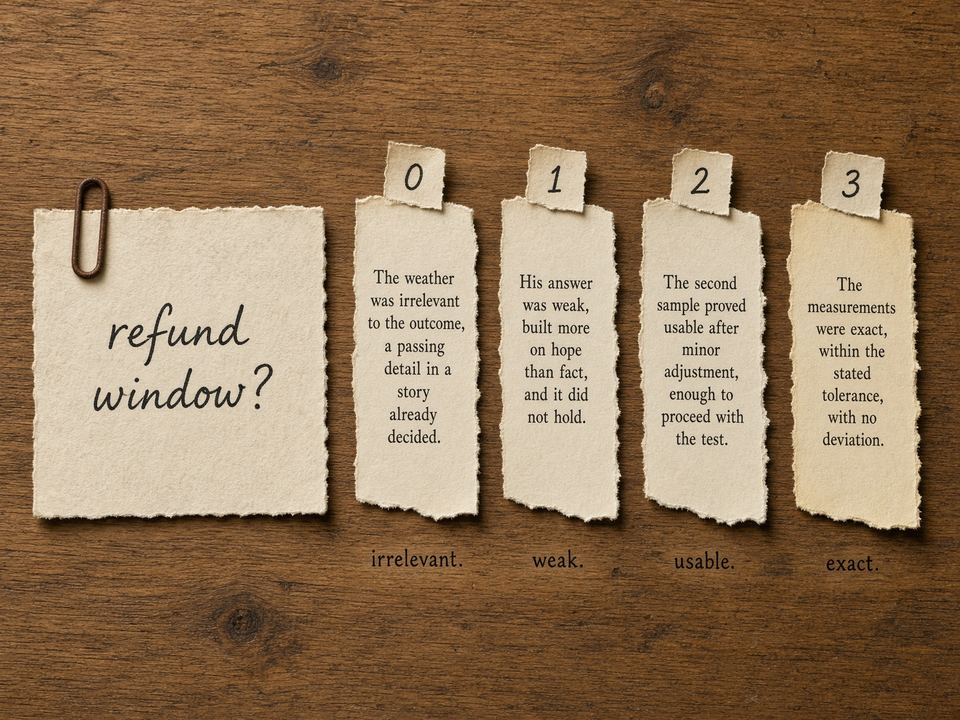
Score each retrieved chunk on a 0–3 rubric before it is stuffed into the writer prompt.
Open pattern
Given a claim and a passage, choose supports, contradicts, or says nothing.
Open patternThis is a category contrast, not a quality war. Use an LLM to write. Use Jev Patterns to judge, route, and gate. TypeSafe Jev returns typed decisions. Chat products return language.
| LLM string generation | Jev Patterns / System One |
|---|---|
| Samples tokens until stop. You parse the string. | Constrains the answer space by construction. No text to parse. |
| JSON mode still emits field values as language. | Choice / Score / Noul return distributions over the criteria you declared. |
| Confidence is a vibe in the prose. | Confidence is how peaked the distribution is. Branch on it. |
| Great at writing, summarizing, chatting. | Great at routing, scoring, and gating. About 70–500ms. No generation. |
state at your ticket, chunk, form, or tool result. Keep the question keys stable so logs stay comparable.https://api.typesafe.ai/v1/systemone with model: "jev-latest", or run the fixture in the Jev playground first.Platform engineers wiring support queues. Agent authors who need a next tool enum instead of another parser. RAG owners who want a chunk Score before they spend a writer turn. Trust and safety teams who need parallel Nouls, not a chatbot that explains the violation. If you are looking for a ChatGPT clone, you are on the wrong site. See when not to use Jev.
Jev Patterns is published on jevpatterns.com. It is not a product of TypeSafe AI. Official documentation remains docs.typesafe.ai. Read about for the full disclaimer.
No accounts. No hosted quota. No chat widget. No purple gradient. No promise that a schema is calibrated on your labels. Jev Patterns is the missing catalog between a model launch and a production switch statement. If you need TypeSafe to sign a DPA, that is their site. If you need a department Choice that will not emit “finance,” that is this site.
Next
Last reviewed 2 October 2026. Independent of TypeSafe AI.